










Setting boundaries with wedding clients is something we all know we should be doing, and listen, plenty of us do have a boundaries problem. But here’s what I’ve noticed as a coach: there’s something deeper at play, and it’s the real reason you’re answering client texts from your dinner table, your kid’s softball game, or the beach on a Saturday.
Somewhere along the way, our industry decided that exceptional service means being reachable at all hours, and friend, it’s draining your energy, your focus, and eventually your love for this work.
In this episode, I’m breaking down a distinction that changed the way I run my own business: the difference between being available to your clients and being accessible to them. They sound like the same thing. They are not. And once you see it, you can’t unsee it, in your inbox, your DMs, or your nervous system.
I’m also pulling back the curtain on how I handle this in my own coaching business, including the one phrase I let stand as a complete sentence, and why the fastest response is almost never the best one. Your clients aren’t paying you for speed. They’re paying you for your expertise, and I’ll explain why the way you’re working right now might be getting in the way of delivering it.
If you’ve been feeling exhausted by your business and blaming your client load, this conversation might surprise you. Plus, I’m giving you one simple practice to try this week that will show you what’s really happening when you’re “off the clock.” Hit play, and then send this one to your business bestie who answers texts from her dinner table. You two need to talk this out.
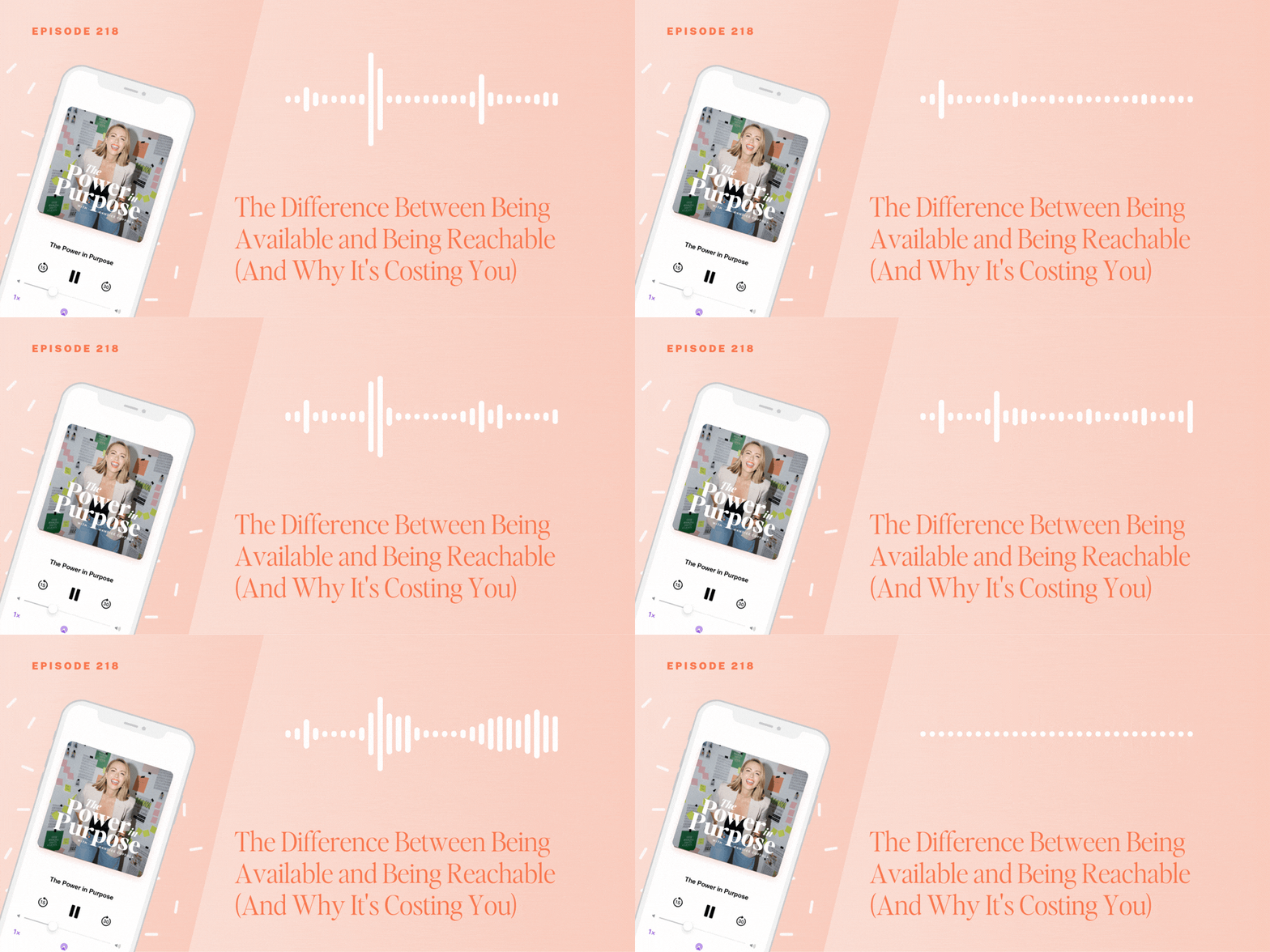
In this episode about setting boundaries with wedding clients:
- [03:09]: The women I coach who feel the most exhausted in their business do this
- [04:47]: Do you need to be responsive 24/7 to have a great client experience?
- [06:27]: The problem with all the open loops you have open right now
- [09:42]: Why setting boundaries with wedding clients makes good service possible
- [14:20]: What to do with emotional responses
- [17:26]: One of the ways I handle this as a business coach
- [19:23]: Protect the state that you serve your clients from
- [24:18]: One practice I want you to try this week
Candice (00:02.872)
Hey, it's your coach Candice. Have you ever finally sat down for dinner, taken one bite, and then your phone buzzes? It's a client. Nothing is actually wrong. They're just asking a quick question. So you answer. And then another message comes in. And before you know it, you've spent 15 minutes standing in your kitchen talking through something that probably could have waited until tomorrow. And there's something that really fascinates me about this as a business coach.
You probably don't even question this anymore. You just think, well, that's part of the job. Today, I want to challenge that belief because I don't think most wedding pros have just a boundaries problem, although many of you do. I also think you might have an access problem. So today we're talking about the difference between being available to your clients and being accessible to them. Why does that matter?
Well, one builds trust and the other starts to drain away your energy, your focus, and eventually your love for the work.
So if you're a service provider who prides yourself on delivering an incredible client experience, today's conversation is for you. Let's get into it. Hey there, friend. Welcome back to the Power and Purpose podcast. If you're new here, gosh, I'm so glad you're here. Hi, I'm Candace. I'm your business coach, your former wedding planner extraordinaire who built a beautiful. Let me start that over again. I don't know where my mind went. Sorry, Haley.
Hey there, friend. Welcome back to the Power and Purpose podcast. I'm so glad you're here. If you are new, hello, I'm Candace. I'm your business coach. I'm a former wedding planner and designer who built and sold a successful business before I started doing all of this, coaching you. I'm so glad you found us. Do me a favor, hit follow so that next Tuesday's episode lands right in your feed without you ever having to think about it.
Candice (02:05.292)
And to all of you who have been my rider dies, whether this is the second episode you're listening to or the 217th episode, I want to thank you for coming back for another week. You already know I've always got you. And today's episode is a no exception. So if you've got a business festie who is answering her client text from her dinner table.
I think you need to send her this one. Please make sure to forward it to her because you two need to talk this out. If today's episode does spark something in you, I would love for you to take this conversation to some of your vendor friends and talk about this. It's so great to listen to a podcast and get new ideas. It's even better if you take those ideas to your community and start talking about it. And just a shameless plug if you're looking for a community or someone to talk to about.
All the crazy shit that happens as you run a business, you know I've got you there as well. If you're a planner, make sure you check out the planners playbook, which is my community and educational space for planners. And if you are a planner or anything else in the wedding industry, I have an amazing mastermind called Wedding Pro Insiders. And we are talking about boundaries all the time inside WPI. So feel free to go to weddingproinsiders.com to learn more about that coaching experience.
So I want to start with something that I've been noticing more often than not, and that also I have personally dealt with in the past. The women and folks that I am coaching, the ones who are feeling the most exhausted by their work aren't always the busiest. However, we are in busy season, so that does change the scope of things. But something I have noticed is the most exhausted women I coach.
Are not necessarily doing more weddings, they're not even working with maybe more difficult clients. They're usually folks who have allowed clients to have the most access to them. And now, before anybody gets defensive, I'm not saying that you're doing anything wrong. In fact, I think most of us were kind of taught this somewhere along the way in our wedding industry journey. We started equating exceptional service with unlimited access.
Candice (04:25.75)
I've been saying recently that the wedding industry has equated service with servitude. We feel like in order to provide an incredible service, we have to serve people in in an ungodly way. We have to be extremely accessible.
And if you are responsive, then you are a great imitation designer, florist, planner, photographer. If you answer quickly, it shows people that you're committed and that you care. If you text back on a Saturday while you're out with your family at the beach, you're high touch. And for some reason, we've kind of turned this into a bit of a badge of honor. But I want to ask you something. Is that actually what creates an incredible client experience? Is being accessible.
At all hours of the day, actually good for the experience you want to create. I don't know. I'm gonna argue that perhaps it isn't what creates an incredible client experience. I think we've just accepted it as what we should do. And there's a distinction that I want you to think about. I believe availability is intentional, it's a decision that we've made.
We've decided how our clients are going to communicate with us, when they can expect to hear from you, how you support them, and where your attention goes. That's availability, right? It's designed. Access is different. Access is simply saying how many doors do you have open or how many have you left unlocked? Can they text you? Can they DM you? Can they email? Can they call?
Can they reach you at dinner on vacation at 9:30 at night? Those are two completely different things. And I think we've convinced ourselves that the more access clients have to us, the better the service. I don't think that's true. And in fact, I think unlimited access often creates a worse experience, not just for them.
Candice (06:36.076)
But also, obviously, for you. So it creates a worse experience for everybody. I want to talk about what this is actually doing to you. I'm going to deliver some bad news. But you know I'm going to help you fix it. So I'm going to deliver some bad news before I help you. Every open door to you costs you something. And it's not just your time, it's your capacity.
I am willing to bet that you have about a thousand open loops right now between what to cook for dinner, what route you're gonna take to avoid traffic, what podcasts you're gonna listen to, what emails you have to respond to, outstanding tasks on your to do list, the person you have in text back that's your best friend that you have to reach out to and say hello, the birthday card you have not bought for your godchild's.
And a million other open loops between personal and professional. And these open loops wear down on your capacity. Now, when you're reachable on every channel at every hour, absorbing every client's stress, literally, as it happens, your body is never getting the signal that you're off.
You're never telling your body, okay, roll the credits, movie's done. Now I can be offline. And what I found, and what in my own experience, perhaps this is very true for you, is that you're in a low, kind of low grade state of bracing all day long. Waiting for that next text, the next phone call, the next email, the next DM, the next quick question, and of course the next.
Fire, the next mistake, the next thing that you got wrong, somebody else got wrong, the next question, the next demand. My my my my heart is pumping right now. Willy to bet you're thinking, my God, free me from this, Candace. What do I do? Before I do that, I want to tell you that you're not actually serving your clients better when you're dysregulated. You are making decisions from a very frayed nervous system.
Candice (09:03.51)
And we're calling this being dedicated, being all in on your business, being responsive, being a person who answers messages within 30 minutes. And the exhaustion that you're feeling is not because maybe you have too many clients, although for some of you that probably is the case. But I think it's more because you've given each of them unlimited access to you. And to a body, to a person.
Who actually does have a limited capacity? Like you you you do have limits.
And I wonder if you even know what your limits are. If you even know what your true capacity is to be in balance, to be feeling good about the work, feeling good about how accessible you are to clients, and closing loops instead of opening more.
Candice (10:06.402)
I like to think of it like this, and I'll use a planner as an example. A planner that is reachable reacts. A planner that is available responds. I think that your clients actually deserve the second one, somebody who responds. I also think you deserve it too.
I don't think that you can give your client your very best thinking when you are operating from a depleted nervous system, but also from an exhausted, overcapacity mindset. And so the boundary here isn't the opposite of good service. This is what actually makes good service possible. What if you thought about your boundaries that
Way? What if you thought about how accessible you are, when people can access you, how they can access you as a way of providing the best service, the best responses, the best thoughts and ideas, especially if you're a creative. I mean, if you're creative, you have to take your time getting your creativity where it needs to be to produce. And if you are
constantly reacting to things, always accessible, your creativity is going to suffer.
And so I know this all too well, and I know it firsthand because there have been many eras in my life where I was way too accessible. I was way too accessible as a planner. I was way too accessible as a coach. And this is the work that I have personally done and help people do for themselves. Now, when you look at my life and where I'm at in my career today, I support people for a living. And I
Candice (12:01.012)
Support people who are in real distress about their business, their money, their dreams. Not every message in my Voxer is pleasant in the sense that the the the the challenges are there and there is a lot at stake for people. And that is a a a pressure that I proudly wear and that I'm able to take on, but not because I'm just built different.
It's because I really tried to think about how I want to support people and be accessible and available for them so that I can rise to the occasion that they need in order to help them. I had to learn how to be genuinely present for these difficult conversations without letting it run me into the ground. And also making sure I'm providing really great advice to people. So
Here's what I do. I decide my availability before anybody asks for it. My hours, how you can reach me, my response windows, all of those things are set in advance in writing. So there isn't no wondering when I'm available and what the expectations are. I don't negotiate my boundaries anymore. I have them because it is what helps me provide an amazing service for my clients. And I have
To be honest with you, I don't think anybody cares that I'm not available 24-7. Everyone respects my time. They respect how quick I respond. They respect my time off. I have really great clients. Now, granted, they're all business owners, so they understand, but there have been challenging moments where I wasn't as available or as accessible as I would like to be, and nobody faulted me for it.
I don't negotiate my boundaries anymore. So when I'm tired, I don't respond. When I am not in the best frame of mind, I don't open up my messages and search for voice notes or texts that are going to stress me out. And I don't want you doing that either. So I want you to think about your availability and accessibility.
Candice (14:26.38)
And start to make some changes around how accessible you are. Now, it's not just hours, how they can reach you, what channels and response windows they can expect. It's also about emotion. And so here's another thing that I don't do. I don't answer from inside the emotion. When somebody comes in hot, I let there be a little bit of a gap between.
Maybe their panic or their stress and my response. And this is definitely not because I don't care. I care a lot. And in some instances, the panic, the stress is very warranted. Running a business is challenging. There's a lot at stake. I often tell clients when I do not have the answer straight away.
Or when I need time to think about something, I let them know. I let them know I'm gonna put my mind to this and get back to you. And that's not because I'm incapable of answering the question or solving the problem, but it's more about I need time to think, to sit with what you're asking me and provide you with the very best response. Also,
We take on other people's emotions. So when somebody does come in hot and there's this emotional exchange, you're taking in their emotion, stress, panic, frustration, anger, and you might mirror that emotion back.
And I don't think that's actually the right thing to do when you are a trusted expert, when you're supposed to be the guide. What I found is the version of me that answers even just an hour later is so much more useful to the person than the version who answers in two minutes, very activated, taking on the same energy that I am feeling from my customer.
Candice (16:38.134)
And that pause that I take is actually part of the service. Bring the temperature down a little bit, let me think on things, let me stew on things, and then I can come back to you with some really grounded advice after I've put my mind to it. So I don't answer from inside hot emotions, panic, stress. I don't answer right away. I take at least a few minutes to think about it.
If not just a little bit of extra time. And guess what? That's what my clients are paying me for. They're paying me for really good advice. Your clients are paying you for the same. You're an expert. They're paying you for your expert advice. If you are overcapacity, stressed, anxious, dysregulated, and then somebody is coming to you.
From a similar state, asking you a ton of questions or offloading a lot of energy, you have to be careful about how you take that on. And you want to respond not the quickest, but the most thoughtfully. And that is what clients are paying you for. Another thing I do is I make sure that the doors of accessibility to me are pretty narrow. And I do this on purpose.
My clients know they can book a call, they can come to one of our weekly coaching calls, or they can send me a Voxer note. I don't text with my clients unless it's through Voxer. I don't even answer emails from them. And I bring it back to Voxer because that's what it's for. It's for us to talk, to chat, to have one place to connect. Email is my least favorite place to be, and I
As I'm no longer a wedding planner, I don't have to live there anymore. And I don't say that to show boat, but you can be jealous. It's okay. But I have one or two places where we can connect, not six different locations. So a client knows exactly where to reach me and when and how I'm gonna respond. And just knowing that brings a sense of peace and calm.
Candice (18:59.086)
Clarity around accessibility and what doors are open for your clients is going to regulate both of you guys. Unlimited access doesn't work. And it doesn't make a client feel held or supported. It often makes people feel like they have to keep checking whether you're still there. And they just keep messaging you and sending you things. So if you find that your clients are DMing you ideas.
Texting, calling, emailing, Whatsapping, you've got to rein this in. You have got to really think about how you want to be available and where that accessibility, how you're going to give them access to you and what that access means. And as we're talking about access, I've kind of already mentioned this, but I really do protect the state that I serve people from.
I have a lot going on on my end. You know, I've got my own stresses, my own business, my own life stuff. And so it's important for me that when I show up to record a podcast episode, I do it in the right frame of mind. And when I open up my messages from my clients to answer questions, I do so in the right frame of mind. I'm not in my voice noting app with my clients multiple times a day.
I check it once or twice a day and I respond to messages and I'm okay with that. I'm helping people move forward and I'm opening it up when I am ready to serve. What would happen if you opened up whatever channel you've decided is for client communication and you opened it up during the day once or maybe twice?
When you felt that you were at your best to answer those questions and even troubleshoot some of the problems that might be coming up, you would probably respond from a very grounded place. You would also know that you're likely going to walk into some questions that might activate your nervous system or some situations that might really challenge how you think. And you're okay with that. You know what to expect.
Candice (21:15.436)
You're also in control of how you communicate and when you communicate. So you know that if you're having a really rough morning and you're feeling really stressed out, nervous, and anxious, the last thing you want to do is open up your client communication channel and start receiving all different types of energy. You're just not in the right headspace. And so I protect the state that I serve people from.
I try to respond from a very grounded place and I don't want to catch their stress like catching a cold, which by the way is very easy to do.
So regulating myself first and making sure that I am communicating when I am ready is actually part of the job, and it's part of offering exceptional customer service. I've also mentioned that I do something, which is I'll get back to you. And I let that be a complete sentence when necessary. I don't owe anybody an instant answer, and neither do you. And the truth is, is my clients don't expect
An instant answer. I can only think of one or two instances where there really was a situation happening that deserved a quicker response and they really appreciated that I was able to do that. But I don't think anybody expects me to respond in minutes. I think people understand that I have windows of response times. Your clients likely understand this too. But you might be teaching your client that you'll respond within minutes.
Within windows that she can expect that are actually unattainable to and unsustainable. She might expect that you can respond while you're making dinner because you always do. She might expect if she sees you out on social media and that you're working from the softball fields, that she can message you because she knows you're on your computer and that you're working on a Saturday.
Candice (23:16.402)
If you set good boundaries, expectations, availability windows, and define what access means, they're not going to expect that you respond when you're off the clock or when you're at softball practice. And this is really important. It's also important to let I'll get back to you be a full sentence because not every question or circumstance.
Can actually facilitate an immediate response. I think that being available on purpose, thoughtfully, is one of the most generous things that you can do for your clients. Being reachable all the time, whether it's by accident or even by design, by the way that you've designed, is one of the fastest ways to resent the work you've built your whole life around or this season of your life around. And I'm gonna challenge you to think about service differently.
It's not servitude. You are not indebted to the people that hire you to get back to them in minutes and to be accessible at all hours of the day or night. But it's up to you to choose what that's going to look like going forward and to teach your clients how to treat you by communicating very clearly what they can expect. When you do that,
You are going to have less and less problems with accessibility and expectations around communication.
Candice (25:04.229)
One practice I want you to try this week is set hours for yourself to be plugged into clients and work. And when you're outside those hours, just for this week, I want you to pay attention to how often you're checking your DMs, checking text messages, or whatever app you might use to communicate with clients, checking your client portals, checking your email, looking for
Communication and what that communication does to your body and to your nervous system, and also to the conversations you might have been having in mid-conversation before you checked your phone. I want you to try this week to pay attention to how often you are accessible outside your windows of accessibility. That's the first step. Even better if you can notice.
How you are accessible outside those windows, even better if you can not respond. You might read the message, you know it's there. Unfortunately, you've opened that loop and your desire is to close it. Your desire is to be like, nope, I wanna close that loop. I wanna send that email. I wanna respond to that text. But what if you left the loop open and you responded to it when you were.
of the right mindset in the right time of day, it at your desk when you're thinking about work and when you are able to give a good answer.
Candice (26:46.338)
Thank you so much for listening to today's episode of the Power and Purpose Podcast. I hope that today's episode has got you thinking about accessibility versus availability. As a business owner, you need to be available to your clients, but how much access they have to you is your choice. All right, friends, I'll see you next week. I want to remind you, there's so much power in your purpose. Take care.
Sign up to receive email updates
Enter your name and email address below and I'll send you periodic updates about the podcast.
Thanks for tuning into today’s episode of The Power in Purpose Podcast. I want to know– what was your biggest takeaway? Head to my Instagram to join the conversation!
Explore More Wedding Industry Resources
- The 2026 Growth Strategy for Wedding Pros Nobody Its Talking About
- The Biggest Opportunities in the Wedding Industry Right Now
- The Operating Standards I’m Building My Business Around (Use These To Grow Your Wedding Business)
- State of the Wedding Industry: What I’m Seeing Behind the Scenes of (And The The Old Rules That Don’t Work Anymore)
- Building a Reputation in the Wedding Industry: What People Say Behind Your Back Matters, Here’s Why
- 4 Energy Rules That Changed How I Run My Business (Productivity Hacks for Wedding Pros)
- 23 Lessons I Wish Every Wedding Pro Knew (After 200 Podcast Episodes)
- This Is Why You’re Not Getting Wedding Referrals More
- 10 Bold Shifts High-Achieving Wedding Pros Are Making Right Now (That Are Actually Working)
- Is a Wedding Mastermind Worth It? My $60K Education Journey + 7 Signs You’re Ready & 3 Signs You’re Not
For more business tips and a look into my island life, follow me on the ‘gram
I haven’t worked this hard or this much in years. I’ll be honest, it’s been both rewarding and exhausting. There’s a lot happening behind the scenes and so much to do. But the one thing driving it all is my passion to help as many wedding and event planners find a forever home for their business that makes the work you do easier. We are so close to being ready 🙏
A special thank you to every client of mine who has encouraged me and cheered me on, and every beta tester who has started using Cue. Your feedback, excitement, bug spotting, ideas, and presence has meant more than I can ever express!
I also want to thank everyone who has signed up for the waitlist, shared Cue, or reached out to me personally. I am SO excited for you to see what we are building for you and your excitement for Cue has motivated me beyond what I thought I was capable of. 💜
There’s still time to get on the waitlist for Cue and see what the fuss is all about. Comment CUEWAITLIST and I’ll send you the link to get in line to be the first to try out Cue when we launch on 12/1!

Still catching up on sharing our April mastermind retreat (because apparently I need six months to recover from hosting 🤣). Here’s day three: WPI at sea.
Every year, I treat the ladies to a catamaran cruise here in Barbados, and every year, I remember why this is a nonnegotiable on our itinerary!
We swam with turtles, had a beautiful lunch, drank wine, did tequila shots, and talked about work and life while floating around in the Caribbean. Honestly, a very productive day in my books!!
One of my favorite things about coaching these women is getting to know who they are outside of their businesses. And getting to spoil a group of women who are usually the ones making everything special for everyone else? I’ll happily do that every year.
I love these ladies. I love this little island. And I love that my job brings us all together, preferably on a boat with someone else handling lunch.
Applications for WeddingPro Insiders are open, and we have a handful of spots. If you want to spend the next year working on your business with us, then come hang out at my house in April 2027 and experience this for yourself, I’d love for you to apply.
Head to the link in my bio for the details, pricing, and application. Come meet your people. 💜💜💜
Special shout out to @breezy_days_barbados for the *incredible* day and to @c10ike for the photos!!
Buying stuff regulates my nervous system 🤷🏼♀️
Some of the links used in this blog post are affiliate links. When you purchase something, our company receives a small compensation at no cost to you. This compensation helps to maintain the cost of creating helpful content, like our podcast, so you can build a profitable business with purpose.
All, Getting Down to Business, Growing a Business, Mindset's To Fix, Podcast Show Notes, The Client Experience, Things to Do Better
filed under:





















+ show Comments
- Hide Comments
add a comment