










When it comes to diving into the wedding planning industry, one big question often looms: Should you start your own wedding planning business or gain experience working for someone else first? After all, maybe you found this post because you were looking to get a wedding planner job?
In this article, we’ll break down both options, helping you weigh the benefits and challenges of going solo versus learning the ropes under an established planner. By the end, you’ll have a clearer sense of which direction might be the perfect fit for your wedding planning dreams.
Spoiler alert: Before we even get started, I want you to know there’s no one-size-fits-all answer. Everything we talk about today is subjective – but don’t worry, I’m here to help you figure out which path might be right for you. So grab your notebook (or, let’s be real, open another tab on your already overcrowded browser), and let’s dive in!
(And if you want to skip getting a wedding planner job and jump right into starting your own business, you’ll want to register for my free masterclass: How To Launch Your Wedding Planning Business THIS Year – And Book Your First 5 Clients!)

Option 1: Starting Your Own Wedding Planning Business
When you think about starting your own wedding planning business, there’s a lot of pros. Time freedom, making tons of money, everything else you see online, right? But if I’m being honest, there’s more to starting your own wedding business than posting on Instagram that you’re open for business (or lurking around in Facebook groups that you joined when you were getting married). In fact, I always say the moment you open up your own wedding planning business, you become a business owner, and wedding planner second.
Let’s talk about the quick pros and cons of starting your own wedding planning business…
Pros:
- You’re in charge
- All the profits go straight into your pocket (hello, designer shoes fund!)
- Creative freedom to build your brand and style
- Flexibility to work with your dream clients
Cons:
- It’s sink or swim, baby – no safety net here
- You’ll be wearing ALL the hats (CEO, accountant, marketer, therapist…)
- Steeper learning curve
- The buck stops with you (pressure, much?)
Now, let’s talk about trying to get a wedding planner job at an established company instead!
Option 2: Trying to Get a Wedding Planner Job
If you want to learn the ropes from a seasoned pro (with a steady paycheck in hand, without the stress of running the whole show), it might be worth it to you to head out and search for a wedding planner job that already exists. But let’s talk about the pros and cons of that…
Pros:
- Learn from someone else’s mistakes (and successes!)
- Steady income while you figure out if this is really your jam
- Network and build connections in the industry
- Focus on honing your skills without the business headaches
Cons:
- Less creative control
- Smaller piece of the financial pie (probably the biggest reason people choose to start their own business)
- You might outgrow your role with no place to advance
- Zero time freedom (you’ll likely have set hours if you’re working for a company)
It can be hard to find a wedding planner job
The other con that nobody talks about? It can be kind of hard to find a wedding planner job. Everyone talks about “gaining experience” by working for another planner, but here’s the kicker: Those jobs are rare.
Most wedding planning businesses are small operations. We’re talking about solo entrepreneurs or tiny teams. They’re not exactly lining up to hire fresh faces off the street. The few positions that do exist? Often filled by long-time team members who’ve clawed their way up from intern to assistant to planner.
If you’re set on getting a wedding planner job (instead of going out on your own), I recommend looking at venues to see if they are looking for venue coordinators. While it’s not exactly the same role, it’ll get your foot in the door and there are more positions available.
I Started My Wedding Planning Business With ZERO Experience
Now, let me let you in on a little secret. When I started my wedding planning business, I had exactly zero experience. Nada. Zilch. The closest I’d come to event planning was being a hostess at a restaurant. (Spoiler: Seating hangry couples is NOT the same as planning their wedding.)
But guess what? I did it anyway. I launched that business, learned as I went, and eventually sold it. Now I’m here, teaching fabulous people like you how to do the same.
The moral of the story? If one of the reasons you’re looking to find a wedding planner job is that you’re nervous to start your own business, don’t be. Yes, it’s a lot of work but you’ve done hard things before. Sometimes, you’ve just gotta take the leap and trust that you’ll figure out how to fly on the way down.
So, What Should You Do If You Want to Be a Wedding Planner?
1. Assess Your Risk Tolerance
Becoming a wedding planner often means diving into the unknown, especially if you’re starting your own business. Are you someone who thrives in uncertain environments, or do you prefer the security of a steady paycheck?
Understanding your comfort level with risk is crucial. If the thought of unpredictable income or dealing with last-minute changes fills you with dread, it might be worth considering whether this career is the right fit. On the flip side, if you’re energized by challenges and excited by the idea of being your own boss, wedding planning could be a great opportunity for you to thrive.
2. Check Your Local Wedding Industry Market
Before you jump into the wedding planning industry, take a good look at what’s happening locally. Research whether there is a demand for wedding planners in your area. Are there already established planners with strong reputations, or is there room for someone new? If the market is saturated, don’t get discouraged. You might need to get creative with your niche or consider relocating to a more promising area.
There’s ALWAYS room for someone new, trust me.
Conversely, if there’s little competition but a strong market, you could have a golden opportunity to establish yourself. Understanding the local landscape will help you make an informed decision and avoid potential pitfalls.
3. Be Honest About Your Skills
Wedding planning isn’t just about organizing beautiful events; it also involves running a business. Take a hard look at your skill set. Do you have the necessary organizational skills, creativity, and business acumen? Are you confident in your ability to handle finances, marketing, and client relationships?
If you feel you’re lacking in any of these areas, consider seeking mentorship or further education before diving in. A solid foundation of skills can make the difference between a successful business and one that struggles to get off the ground. Join me inside the Planner’s Playbook, my membership for wedding planners, if you want ongoing support as you start this new venture!
And if you’re looking to START your wedding planning business, make sure you sign up for my FREE masterclass. Click here to register for free now!
4. Trust Your Gut
Sometimes, no matter how much research or planning you do, the decision comes down to what feels right. Your intuition can be a powerful tool in making decisions. If every fiber of your being is telling you that wedding planning is your calling, it’s worth listening to that inner voice.
Just remember to keep your instincts in check with reality; while it’s important to trust your gut, make sure your dreams are grounded in a solid plan. You can download my FREE business plan template to help you get started.

The Bottom Line on Getting a Wedding Planner Job
Whether you choose to launch your own wedding planning empire or set out to find a wedding planner job, remember this: There’s no “right” way to become a successful wedding planner. It’s all about finding the path that works for you, your goals, and your fabulous personality.
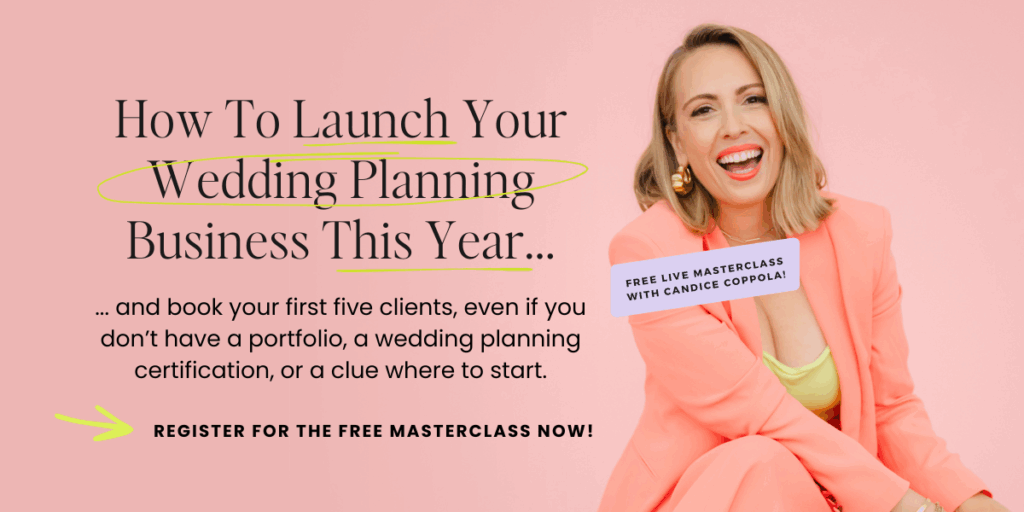
And hey, if you do decide to start your own biz, I’ve got your back. Sign up for my FREE live masterclass, where I’ll teach you how to start your wedding planning business this year and book your first five clients – even if you don’t have a portfolio, experience, or a clue where to start!
Explore More Wedding Industry Resources
- How to Start a Wedding Planning Business
- How to Become a Certified Wedding Planner
- How To Build Your Portfolio As A Wedding Planner When You’re Just Starting Out
- How To Go From Side Hustle To Full Time Wedding Planner
- Creating Wedding Planner Packages for Your Business: How To Find the Best Way To Position Your Offer
- 6 Things You Need to Include In Your Wedding Planner Pricing Guide
- Here’s What Every Wedding Planner Needs To Include In Their Wedding Design Proposals
- Wedding Planner Pricing: How Much Should You Charge As A Wedding Planner? Learn How To Figure Out Your Price
- Pricing Mistakes You Can’t Afford To Make In Your Business As A Wedding Pro
- 6 Ways Wedding Planners Leave Money on the Table
- 5 Ways to Make More Money As A Wedding Planner
- Why Honeybook Is The Best CRM for Wedding Planners
- How Much Does It Cost to Become a Wedding Planner?
- Wedding Planners – Should You List Your Wedding Planner Pricing Packages On Your Website?
- Day of Coordination: The Pros and Cons as a Wedding Planner
- How To Sell Your Wedding Planning Services: The 7 Stages Of The Sales Cycle
- 5 Contracts Every Wedding Planner Must Have To Be Legally Set
- How To Get Wedding Clients When You’re Just Starting Out
- Are Your Wedding Industry Sales Down? Here’s How To Figure Out What’s Wrong
- 9 Mistakes to Avoid When Starting Your Wedding Planning Business
- How to Book Destination Weddings And Elopements In Your Wedding Business
- Why You’re Not Attracting The Right Clients and How to Fix It
- How To Become A Wedding Planner With No Experience
For More Wedding Planner Business Secrets Follow Me On Instagram
Today I got to share Cue with my DI mastermind, and I’m feeling really proud. 🥹
I’ve been so busy building it that it felt good to stop for a minute and share the story with a room full of people I love and admire. So many smart, talented, generous people who I’m lucky to call my friends.
This was a special one. ❤️
Would you guys like to hear what I shared? I’m thinking about breaking it down into a series here on Instagram. Should we do it?
@ninelemonsfengshui encouraged me to share it with you all here, and I think I should. LMK in the comments if you’d be interested in my presentation from today!

Day one in Charleston for the DI Mastermind, and I spent ten hours of it in my hotel room working on Cue. I’ve been at it since 7 a.m., trying to get client portals ready, and I didn’t get as far as I’d hoped.
But I did close my laptop long enough to hug some of my mastermind friends, catch up before sessions start tomorrow, and see this.
I’d love to tell you this sunset inspired some profound revelation, but mostly I think I needed to leave my fucking room. 😂
Although maybe that’s the reminder: there will always be something that needs more of me. I’m allowed to step outside and enjoy where I am before everything is finished.
And so are you! 💜
I’ve been doing brand shoots for almost 20 years, and I have opinions 😂 Here are 9 things that make them great:
1. Hire a photographer who specializes in brand shoots. There’s a big difference in quality when you work with someone who understands how to photograph you AND your business. Go with the best you can afford.
2. Book more time than you think you need. An hour is nice for headshots, but multiple outfits and scenes take hours. If you want lots of variety, give yourself time to create it. If you’re going to do it, go big and do it right.
3. Know how you’ll use the photos. Your website, social media, launches, presentations—tell your photographer what you need. Plan for different crops, orientations, and room for text.
4. Have a creative direction. Build a mood board so everyone understands the vibe. Think about the story you want the photos to tell before you show up.
5. Dress for where your brand is going. This is your chance to show up as the version of yourself you’re stepping into. Bring outfits that make you feel like her.
6. Get your photographer involved in the planning. Ask for their input on locations, outfits, lighting, and timing. You hired an expert—let them help shape the shoot.
7. Plan actual scenes. Hosting, teaching, designing, creating—what are you doing in the photos? Build moments around your work so you leave with more than portraits.
8. Don’t spend the entire shoot behind a laptop. Your business has more personality than that. Give people something interesting to look at.
9. Bring someone to help. Someone to handle outfits, fix your hair, catch a twisted necklace, and keep things moving. Those extra hands make a difference.
Which photo from @c10ike is your favorite?
Off to spend a week in Charleston (my first time!) for @juliecchenell Digital Insiders Mastermind. I absolutely love getting to spend a week with my colleagues and business friends.
We share meals and ideas and laughs and horror stories and wins and it’s truly the best thing ever. If you’re not already in a mastermind group for your business that allows you to get together once or twice a year, I HIGHLY recommend it! I always leave these events feeling inspired and motivated.
This year I get to share with the group my journey in building @planwithcue and I’m both excited and nervous to share what I’ve been working on. Wish me luck!
To my DI crew I can’t wait to see you soon!!!!!!!
filed under:














+ show Comments
- Hide Comments
add a comment