










So, you want to learn how to become a certified wedding planner? Maybe you’re dreaming about launching your own wedding planning business, or you’ve already started planning weddings and wonder if a certification is the next logical step. You’ve seen those “official-looking” courses online promising certificates, credibility, and instant success. But before you spend a dime (or dozens of hours), let’s talk about what really matters when it comes to becoming a successful wedding planner.
I’m going to be really honest here… most wedding planner certifications are outdated, overpriced, and don’t actually teach you how to run a thriving business in today’s wedding industry. And while it might feel like you need some kind of formal title to prove you belong here… you really don’t.
What you do need is a plan.
In this post, I’m going to break down what certification actually means (and what it doesn’t), whether it’s truly necessary, and what you really need to build a profitable, modern wedding planning business whether you have a certification or not.
By the end, you’ll have a clear, actionable path forward. Plus, a recommendation that’s going to save you time, money, and a whole lot of second-guessing.

Do You Need a Certification to Be a Wedding Planner?
One of the first questions new planners ask is whether they need to get certified to be taken seriously or build a real wedding planning business. And it’s a fair question, especially when there are so many wedding planning programs out there promising success with a “certification” at the end.
But… the wedding industry isn’t regulated. So before you drop thousands of dollars on a course that promises instant success, let’s talk about what becoming a certified wedding planner actually means, and whether it’s necessary to grow a successful planning business.
What Does “Certified Wedding Planner” Actually Mean?
There’s no single governing body for wedding planning certifications. That means anyone can create a course, issue a certificate, and call it “official.” While some programs do offer valuable foundational knowledge, so many are outdated, overly focused on textbook theory, or completely disconnected from what it really takes to run a wedding planning business today (in 2026!).
Their videos are several years old, the templates they offer worked in 2011, and in some cases – the people teaching have NEVER been a wedding planner!
You might learn about traditions or etiquette, but rarely will these programs teach you how to confidently sell your services, navigate tricky client situations, or create a streamlined planning process that sets you apart. There’s an entire “business” side of becoming a wedding planner that’s often completely ignored.
Why Certification Alone Isn’t Enough
No certification will automatically land you clients or make you profitable.
Even if you finish a certification course, you’ll likely be left wondering how to:
- Actually book your first clients
- Price your services for profit
- Create timelines and workflows that don’t burn you out
- Market your business in a way that connects with real couples
Most certifications stop short of giving you what you need to actually run a business, which is why so many certified planners still feel lost once they try to launch.
What Couples Actually Care About
On top of that, you know what potential clients will never ask you? Where you got your certificate.
What they will ask is:
- Can I trust you to guide me through this process?
- Do you have a plan and proven process to make my wedding less stressful?
- Do you understand my style, priorities, and vision?
Couples are looking for confidence, clarity, and professionalism, not a piece of paper that says you completed a course. Which means if you don’t have strong systems and client experience strategies in place, a certification won’t do much to set you apart.
So, should you get certified? You don’t need a certification to become a wedding planner. But that doesn’t mean that I think anyone should start a wedding planning business with no training. What you do need are real-world skills, proven systems, confidence in your process, and a smart business strategy that helps you serve your clients well and get paid.
Certifications can offer context, but they aren’t the thing that builds a sustainable, profitable wedding planning business.
What You Actually Need to Succeed as a Wedding Planner
If certifications aren’t the answer, then what actually makes a wedding planner successful?
The truth is, thriving in this industry has far less to do with framed certificates on your wall and far more to do with how well you can run a business, manage people and logistics, and deliver a consistently excellent client experience, again and again.
Here’s what truly matters.
1. Strong Business Foundations (This Is Non-Negotiable)
Wedding planning is creative work, but it is still a business (read this post if you aren’t sure if you want to start a wedding planning business or get a job as a wedding planner). And without solid business foundations, talent alone won’t carry you very far.
You need to understand how to:
- Price your services profitably
- Manage cash flow and expenses
- Create offers that are clear, valuable, and sustainable
- Sell without feeling awkward or salesy
Most certification programs barely scratch the surface here, if they address it at all. Yet this is often the exact area where planners struggle the most in their first few years. Which means you leave a certification program armed with templates and theories, but notreal skills to run a business.
2. Real Wedding Planning Systems
Knowing what to do is different from knowing how to do it, especially under pressure.
Successful wedding planners rely on systems to:
- Onboard clients smoothly
- Manage timelines, budgets, and vendor communication
- Keep weddings running efficiently behind the scenes
- Maintain consistency across every event
Systems are what allow you to scale, avoid burnout, and deliver a high-end experience without reinventing the wheel for every couple. This is where templates, workflows, and repeatable processes become far more valuable than any outdated curriculum.
3. Confidence Built Through Experience
Confidence doesn’t come from being “certified.” It comes from doing the work.
- Handling real couples.
- Managing real expectations.
- Navigating family dynamics, budget constraints, and last-minute changes.
- Getting in the room with other wedding planners doing the work just like you.
Experience teaches you how to think on your feet, communicate clearly, and make decisions that protect both your clients and your business. That confidence is something couples feel, and it’s one of the biggest reasons they choose to trust you with their wedding day.
4. A Clear, Marketable Point of View
The wedding industry is saturated. What makes you stand out isn’t a credential, it’s cutting through the online noise with a clear point of view.
You need to know:
- Who you want to work with
- What kind of weddings you want to plan
- How to talk about your services in a way that resonates
When your messaging is clear and aligned, marketing becomes easier, sales feel more natural, and the right clients start finding you. No certification can define that for you, but the right guidance and strategy absolutely can.
5. Willingness to Learn, Adapt, and Put in the Work
This industry changes constantly. Client expectations shift. Trends evolve. Tools and technology move fast.
The most successful planners aren’t the ones who checked a box once, they’re the ones who continue learning, refining their systems, and improving how they show up as business owners. That commitment to growth is what creates longevity in this career.
How to Vet Educational Resources and Coaches
Once you realize that a certification isn’t the magic answer, the next question becomes much more important:
Who should you actually learn from?
Because while you don’t need a formal certification to become a wedding planner, you do need education, guidance, and support that’s relevant to the industry as it exists today, not how it looked ten or twenty years ago.
Here’s how to separate truly valuable education from outdated or surface-level resources.
Look for Real, Current Industry Experience
The wedding industry evolves fast. Client expectations change. Technology changes. Pricing models change.
The best educators aren’t just teaching theory, they’re drawing from real-world experience:
- Running an actual wedding planning business
- Working with real clients and real budgets
- Navigating modern challenges like scope creep, burnout, pricing pressure, and scaling
- Have a proven track record of helping wedding planners like you get to where you want to go
If the advice feels disconnected from today’s weddings or glosses over the hard parts of the job, that’s a red flag.
Prioritize Business + Systems (Not Just Inspiration)
Inspiration is great, but inspiration alone doesn’t pay the bills.
Strong educational resources should help you build:
- A profitable business model
- Clear services and pricing
- Repeatable systems for planning, communication, and execution
- Confidence in both sales and delivery
If an educational program focuses only on aesthetics, styled shoots, or “following your passion,” without addressing how to actually run a sustainable business, it’s likely not worth the investment.
On top of that, I want you to be cautious of resources that promise:
- Instant success
- Guaranteed bookings
- “Six figures in six months” without context
Wedding businesses grow through strategy, consistency, and experience. The best education sets realistic expectations and equips you with tools you’ll use for years, not quick wins that fade after one season.
Be Wary of Facebook Groups
There are some really great Facebook Groups for aspiring wedding planners with a lot of excellent information and resources – but one thing I want you to be aware of is many users within those Facebook Groups are paid to recommend certification programs.
That doesn’t mean they’re not being honest about their experience, but several popular certification programs either a.) pay their students to share links inside Facebook Groups or b.) force (yes, FORCE!) their students to promote the program in order to be in good standing. I wish I was making that up, but I’m not.
Keep that in mind.
My Recommendation? Skip the Paper Certificate and Do This Instead
If you’re serious about becoming a wedding planner, here’s my honest advice: Skip the outdated paper certificate, and focus on learning how to actually start and run a wedding planning business.
Most certification programs promise credibility, but what they often leave out is the part that matters most: How to launch, price, book clients, and confidently deliver your services in the real world. No amount of credibility matters if you can’t actually make money.
Instead of spending thousands on a credential that won’t book you a single client, I recommend starting with a modern, business-first foundation that teaches you how to:
- Set up your wedding planning business the right way
- Understand what services to offer (and how to price them)
- Start booking real clients, even if you don’t have a portfolio yet
- Build confidence in your sales conversations and consult calls
- Move from “I think I want to do this” to “I just booked my first wedding”
That’s exactly why I created my free live wedding planner class.
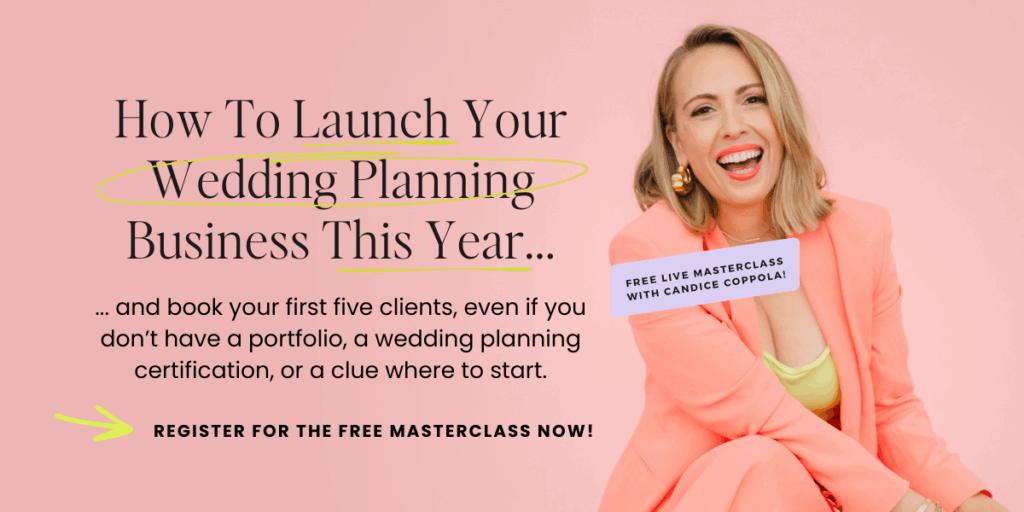
Inside How to Start a Wedding Planning Business This Year (and Book Your First 5 Clients), I walk you through the actual steps it takes to go from idea to income, without requiring a certification, years of experience, or a polished portfolio.
This class is for you if:
- You’re starting from scratch and feel overwhelmed by where to begin
- You’ve planned a few weddings for friends or family and want to go pro
- You’re stuck in research mode and want clear, confident next steps
- You want to build a legit business, not just collect credentials
You’ll learn:
- The biggest mistake new planners make when launching (and how to avoid it)
- A simple framework for setting up services, pricing, and positioning
- How to start booking clients without a logo, certification, or years of experience
- The easiest way to launch your planning business with clarity and confidence
And yes, it’s completely free.
If you’ve been asking yourself “Do I really need to learn how to become a certified wedding planner?” this class will help you see what actually matters, and what doesn’t.
Becoming a successful wedding planner isn’t about having the right piece of paper. It’s about having the right skills, systems, and strategy to turn your talent into a real business.

You Don’t Have to Be a Certified to Be Capable
Let’s be clear about something before we wrap this up: a certification does not make you capable. Your skills, systems, and experience do.
Some of the most successful wedding planners in the industry never completed a formal certification program. What they did do was learn how to run a business, develop strong planning systems, communicate confidently with clients, and show up ready to do the work before they felt “ready.”
Becoming a great wedding planner isn’t about checking a box or collecting credentials. It’s about understanding how weddings actually work, knowing how to lead clients with confidence, and building a business that supports you financially and creatively.
If you’re feeling stuck because you think you need one more course, one more certification, or one more sign that you’re “allowed” to start, this is it.
You don’t need permission, or a certificate. You need clarity, support, and a smart path forward.
That’s why I encourage you to focus on learning what actually moves the needle: how to start your business, how to get clients, and how to deliver an incredible experience once you do.
If you’re ready to stop overthinking and start building, I’d love to help you take that first real step. Join me inside my free wedding planner class and learn how to start your business this year, and book your first five clients, with confidence.
Because you’re already more capable than you think. Now it’s time to act like it.
Frequently Asked Questions About How to Become a Certified Wedding Planner
Do you need to be certified to become a wedding planner?
No. You do not need a certification to become a wedding planner. There is no governing body or legal requirement that mandates certification in order to plan weddings. What matters far more is your ability to run a business, manage clients, communicate clearly, and execute weddings well.
Is a wedding planner certification worth it?
It depends on what you’re hoping to get out of it. Many certification programs focus on outdated information or theory without teaching you how to actually book clients, price your services, or run a profitable business. If a program gives you confidence or foundational knowledge, it can be helpful, but it is not required for success.
What does it mean to be a “certified” wedding planner?
In most cases, “certified” simply means you completed a course created by a private company. It does not mean you’re licensed, regulated, or endorsed by the wedding industry as a whole. Certifications vary widely in quality, depth, and relevance.
Can you book clients without a wedding planner certification?
Yes, absolutely. Many planners book their first (and fiftieth) clients without ever being certified. Couples care about your confidence, communication, experience, and ability to guide them through the planning process, not whether you completed a certification program.
What should you focus on instead of getting certified?
If your goal is to actually succeed as a wedding planner, focus on:
- Learning how to start and structure your business
- Understanding pricing, packages, and profitability
- Creating planning systems and workflows
- Building confidence in consultations and client communication
- Knowing how to market yourself and book clients
These are the skills that make you capable, not a piece of paper.
Can certifications help you feel more confident as a new wedding planner?
They can, but confidence can also come from education that’s practical, modern, and rooted in real-world experience. Confidence grows fastest when you take action, work with real clients, and learn from someone who has actually built a successful wedding planning business.
What’s the best first step if I want to become a wedding planner?
The best first step is to learn how to start a wedding planning business the right way, before worrying about certifications. That means understanding how to launch, how to book clients, and how to deliver a professional experience from day one.
If you want a clear, realistic path forward, start with a resource that teaches you how to build the business itself, like my free wedding planner class.
Explore More Wedding Industry Resources
- 4 Smart Ways to Scale Your Wedding Planning Business This Year
- Should You Offer Wedding Weekend Planning Packages? Here’s The Truth.
- 10 Bold Shifts High-Achieving Wedding Pros Are Making Right Now (That Are Actually Working)
- Should You Increase Your Price? How to Know When It’s Time to Raise Your Rates
- A Complete List of Wedding Planner Expenses
- The Biggest Wedding Pricing Mistakes Keeping Wedding Planners Stuck Under $100K
- 6 Things You Need to Include In Your Wedding Planner Pricing Guide
- Pricing Mistakes You Can’t Afford To Make In Your Business As A Wedding Pro
- How to Get More Wedding Leads from Referrals as a Wedding Planner
- Wedding Planner Pricing: How Much Should You Charge As A Wedding Planner? Learn How To Figure Out Your Price
- Should You Work For Free As A Newer Wedding Planner To Gain Experience? My Honest Opinion
- Why Honeybook Is The Best CRM for Wedding Planners
- Stand Out in a Saturated Market: Performing a SWOT Analysis as a Wedding Planner
- Are You a Disorganized Wedding Planner? Let’s Fix That With These Organized Wedding Planner Tips!
- How To Build Your Portfolio As A Wedding Planner When You’re Just Starting Out
- Day of Coordination: The Pros and Cons as a Wedding Planner
- Wedding Planner Problems: The BIGGEST Problems Wedding Planners Deal With
- How To Get Wedding Clients When You’re Just Starting Out
- 5 Contracts Every Wedding Planner Must Have To Be Legally Set
- How To Become A Destination Wedding Planner
For More Wedding Planner Business Secrets Follow Me On Instagram
Buying stuff regulates my nervous system 🤷🏼♀️

The dates on these photos represent the year I first started coaching each of these women. Some of these relationships are newer, and others go back YEARS.
And I NEVER take for granted how lucky I am to do this work.
To be invited into someone’s business, help her accomplish new things, navigate new challenges, make hard decisions, and push herself in ways she might not have thought possible is a PRIVILEGE.
Because the work we do together is about so much more than growing a business.
I think there’s a big difference between learning from someone and having someone as a constant in your life. Someone who knows your business, history, understands what you’re working toward, and can be both a coach and a confidant through all the different seasons of entrepreneurship.
That’s what I get to be for these women. And what makes it even more special is that we’ve built a community of women who genuinely want to stick around. Not just for me, but for each other.
I feel so incredibly fortunate that these women continue to invite me into their businesses, year after year. It’s a privilege I don’t take lightly.
If you’ve been looking for a business coach who can be that person for you, I’d love to invite you to come hang out with us.
Applications for WeddingPro Insiders are open, and I have a handful of spots available.
Maybe next year, we’ll get to add your picture to this wall, too!!
Learn more and apply at weddingproinsiders.com
Photography @c10ike !!!
We don’t know where that energy has been, and frankly, I’m not taking any chances.
Before you move your wedding planning business to Cue, we’ll be conducting a brief spiritual background check on your laptop. The dogs are licensed. Please cooperate.
Comment CUEWAITLIST and I’ll send you the link to join the waitlist. Cleansing included.
filed under:














+ show Comments
- Hide Comments
add a comment