










I remember the first moment I decided to become a wedding planner. I was on the couch recovering from having appendicitis and somehow ended up binge-watching a wedding show on TV. The next thing I knew, I sent my then boyfriend to the store and stocked up on bridal magazines. I spent the rest of the weekend daydreaming and imagining what my wedding planning business would look like. Over a decade later, I realized now more than ever that the more things change, the more they stay the same. If you have ever had the urge to start your own wedding planning business and wonder how much it costs to become a wedding planner, this post is for you.
Like any business, there ARE costs associated (of course!), but if you feel the nudge, I want to make sure you have everything you need to get started.

First, I’m going to break down how much it costs to become a wedding planner into different categories so you know exactly how much to budget for as you start your wedding business.
Hold up – let me just hop on my soapbox for a sec. You might be bootstrapping right now, and I respect the hustle. But as you read through the information below, I want you to always keep in mind what it’s costing you to save money. Some of these expenses COULD be avoided. But I’m here to tell you – there is always a cost. Saving money by skipping a formal CRM (like Honeybook) and doing every single thing manually (which will, at best, only cost you your precious time) or something with larger financial consequences (like dealing with the IRS because you didn’t register your business), will always cost you.
Start-Up Costs: Wedding Industry Education
There’s no one-size-fits-all when it comes to wedding industry education. I’ll be the first to tell you there is a lot of noise out there. When it comes to wedding industry education, you can take an online course, sign up for an event planning management program at your local college, or even sign up for one-on-one coaching with a top wedding planner in your area. Even here at Candice Coppola Headquarters, we have a few different options at different price points and levels of support.
The reality is education costs cost anywhere from $57 (like the Planner’s Playbook) to $1000+. More expensive isn’t always better, but it is important to take your investments in your wedding planning education seriously and focus not only on marketing your business but also on delivering what you’re marketing.
Like we say inside the Planner’s Playbook, with weddings: there are no do-overs.
This is one of the biggest mistakes I see wedding planners make. So often, I see wedding planner coaches focus so much on getting you new clients and not enough time focusing on making sure that you’re ready to actually execute the services you’re offering. Shameless plug here: that’s exactly why I created the Planner’s Playbook. With a monthly focus, I made it to deliver everything you need to grow (and thrive in) your wedding business.
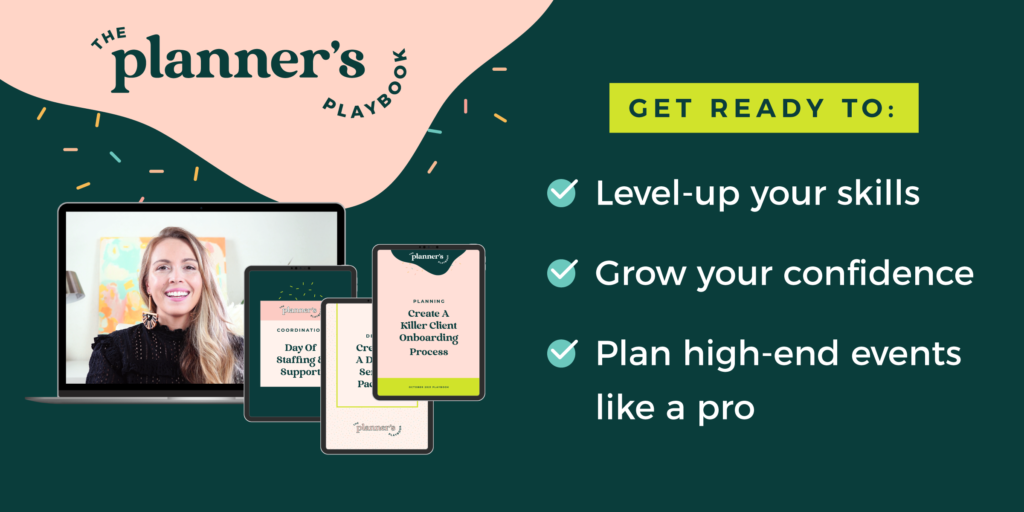
If you have been in business for less than three years, the Planner’s Playbook was designed to provide all the training and support you need as a wedding planner to design, coordinate and plan high-end weddings like a pro. It’s your secret to those magazine-worthy weddings on your vision board!
The last Planner’s Playbook was 57 pages to give you an idea of what your $57/month gets you. I can promise you it is the best money you’re spending on your wedding business right now. And customer experience is important to me, so I can just tell you: I mean what I say.
Start-Up Cost: Register Your Business!
To use some round numbers, I’m going to ask you to budget about $300 for this as a one-time cost, but make sure to check into your own individual state regulations.
Do not skip this step because the longer you let the legal stuff slide in your business side, the harder it will be to ever get legit. Not to mention, the last thing you want is to plan a million-dollar wedding and find out that the business insurance you bought is invalid without a license. It is one of the most important costs to become a wedding planner.
You can use LegalZoom (#notsponsored) tools to get your business up and running. Although, I do recommend seeing a local attorney in your area, too.

Start-Up Cost: Get Yourself a Decent Website
It’s 2022, and there is literally no excuse anymore. You’re going to want to get a legit website with all the bells and whistles. It will likely cost you between $9-$50 a month for everything, but it’s worth it.
When I built my business, I didn’t know any rich people looking for a wedding planner, and I wasn’t getting referrals. I focused on building a solid website and driving traffic using SEO.
Spoiler alert: it’s a lot easier now to build a nice website than it was in 2007.
Honestly, the time and money I have put into my website have paid off tenfold. I’m sure you’re reading this blog post and poking around right now on my website–thinking, “this lady is legit!” First of all, you would be correct. 🙂 But secondly, when you create a gorgeous website for clients to interact with, you immediately have the chance to give a great first impression.
And by the way, not to throw another shameless plug at you, but if you don’t know EXACTLY who your ideal clients are yet, make sure you check out the ideal client cocktail.
Start-Up Cost: Brand Your Business
I will budget a conservative $200 here because I know most of us start our business on a budget. A professional graphic designer might be out of the question, and you can DIY some of this to start.
Plan to invest in some templates from the creative market or something similar if you can’t afford a graphic designer yet. Branding is a place where you always want to invest time. Spend time thinking about and curating your visual brand. Think about your visual brand. You can always change it later, but you’re going to want a solid foundation to help build yourself as a recognizable name in your space. It really is part of the cost to become a wedding planner!

Start-Up Cost: Marketing Expenses
This goes hand in hand with branding. You’re probably going to spend some time browsing stock images, templates, and more. Listen, I know how tempting it is to try and get by using only free stock images. Still, ultimately you’re going to find it hard to differentiate yourself (especially as a new wedding planner) if you find yourself using the same stock photos as everybody else. Paying for a stock photo membership (like Haute Stock or Styled Stock Society) can be very affordable and will give you a leg up on some of the new competition in town.

Start-Up Cost: A Brand Photo Shoot
This is definitely not an area to skimp, so plan on budgeting about $500-$1000 for this. I know it might be tempting to roll with your old iPhone photos, but really, what is the difference between what you and what the wedding planner next door offers? YOU, OF COURSE. People buy from people they know, like, and trust. To really connect with your ideal clients (especially in an online world), they need to see you. They need to know what you look like, what you value, and most importantly, that you believe in investing in your business (before they hand over a huge chunk of change and ask you to plan one of the most important days of your life).
Start-Up Cost: Online Software (like Honeybook!)
Listen y’all know I love HoneyBook so let me just finish off here. HoneyBook is only $4.95 per month. You’ll need a CRM as you grow, and the sooner you start adding automation and consistency to your business, the better. Honeybook lets you send contracts, proposals, and (even better) collect payments. Trust me when I say you are going to become addicted to the cha-ching noise it makes every time you get paid. HoneyBook is truly my secret to how I was able to run a successful wedding planning business like a professional and offer my couples a seamless experience. I know you want that too! When things get missed as a wedding planner, they tend to be missed in a BIG way. Add this to your budget when you’re considering how much it costs to become a wedding planner so you can sleep easily.
Start Up Cost: Legal Contracts & Agreements
One of your final start-up costs as a wedding planner will be to invest in a contract and any other legal agreements needed.
When you start your wedding planning business–you need to have a contract for your clients to sign.
You know that creating the perfect event is all in the details, such as the venue, the decor, the catering. When it all comes together and works the way it should, it’s a great experience for all parties. With that said, a smart wedding planner knows that planning ahead and communicating clearly will prevent issues every time.
This Event Planning Agreement is a contract template that clearly defines expectations, terms, and conditions related to the execution of an event.
It includes:
- List of services being provided on behalf of the event
- How, when, and what method of payment for rendering payment
- Cancellation terms for both parties, and
- Termination clause
This event planning contract template for wedding planners also includes the all-important force Majeure clause, which relieves obligations for both parties in the event of a catastrophic and unforeseen issue.
Your wedding planner contract likely needs some adjustments after 2020 and COVID-19. Be sure to check out the wedding planner contract from Legally Set and save 20% off your purchase with the code PURPOSE.
You can also grab the wedding planner contract bundle at an extra special price, including a styled shoot agreement and an independent contractor agreement!
OK, that was a lot! Let’s recap – when looking at the cost to become a wedding planner, you need to budget for these 8 things:
- Education: ($57-$1,000)
- Business Registration ($300)
- Website ($200+ monthly)
- Branding ($200)
- Marketing Expenses (Stock Images, Templates, etc. $300)
- Brand Photoshoot ($500 – $1,000)
- Online Software ($4.95 per month for Honeybook)
- Contracts and Legal Agreements (grab yours from LegallySet.com and use the code PURPOSE to save 20%)
That’s pretty much it! As you start to build your business, there are a million and one things you can invest in. But as for the bare bones of it all, I would stick with these eight. And don’t forget! One of the best things you can do RIGHT NOW to set yourself up for a successful wedding planning biz is getting on the waitlist for the next time the Planner’s Playbook opens up.
Explore More Wedding Industry Resources
- How To Become A Wedding Planner With No Experience
- How To Get Wedding Clients When You’re Just Starting Out
- Day of Coordination: The Pros and Cons as a Wedding Planner
- How Much Should You Charge As A Wedding Planner? Learn How To Figure Out Your Wedding Planner Pricing
- 5 Contracts Every Wedding Planner Must Have To Be Legally Set
- The #1 Reason Why You’re Not Booking The Right Wedding Clients (And How To Fix It)
- 5 Online Wedding Planning Tools You Need to Use
- 4 Strategies That Will Help You Book MORE Of Your Ideal Clients
- 5 Tips On Crafting a Business Plan To Book Out Your Biz With Your Ideal Clients And Get Paid
For More Wedding Planner Business Secrets Follow Me On Instagram
Today I got to share Cue with my DI mastermind, and I’m feeling really proud. 🥹
I’ve been so busy building it that it felt good to stop for a minute and share the story with a room full of people I love and admire. So many smart, talented, generous people who I’m lucky to call my friends.
This was a special one. ❤️
Would you guys like to hear what I shared? I’m thinking about breaking it down into a series here on Instagram. Should we do it?
@ninelemonsfengshui encouraged me to share it with you all here, and I think I should. LMK in the comments if you’d be interested in my presentation from today!

Day one in Charleston for the DI Mastermind, and I spent ten hours of it in my hotel room working on Cue. I’ve been at it since 7 a.m., trying to get client portals ready, and I didn’t get as far as I’d hoped.
But I did close my laptop long enough to hug some of my mastermind friends, catch up before sessions start tomorrow, and see this.
I’d love to tell you this sunset inspired some profound revelation, but mostly I think I needed to leave my fucking room. 😂
Although maybe that’s the reminder: there will always be something that needs more of me. I’m allowed to step outside and enjoy where I am before everything is finished.
And so are you! 💜
I’ve been doing brand shoots for almost 20 years, and I have opinions 😂 Here are 9 things that make them great:
1. Hire a photographer who specializes in brand shoots. There’s a big difference in quality when you work with someone who understands how to photograph you AND your business. Go with the best you can afford.
2. Book more time than you think you need. An hour is nice for headshots, but multiple outfits and scenes take hours. If you want lots of variety, give yourself time to create it. If you’re going to do it, go big and do it right.
3. Know how you’ll use the photos. Your website, social media, launches, presentations—tell your photographer what you need. Plan for different crops, orientations, and room for text.
4. Have a creative direction. Build a mood board so everyone understands the vibe. Think about the story you want the photos to tell before you show up.
5. Dress for where your brand is going. This is your chance to show up as the version of yourself you’re stepping into. Bring outfits that make you feel like her.
6. Get your photographer involved in the planning. Ask for their input on locations, outfits, lighting, and timing. You hired an expert—let them help shape the shoot.
7. Plan actual scenes. Hosting, teaching, designing, creating—what are you doing in the photos? Build moments around your work so you leave with more than portraits.
8. Don’t spend the entire shoot behind a laptop. Your business has more personality than that. Give people something interesting to look at.
9. Bring someone to help. Someone to handle outfits, fix your hair, catch a twisted necklace, and keep things moving. Those extra hands make a difference.
Which photo from @c10ike is your favorite?
Off to spend a week in Charleston (my first time!) for @juliecchenell Digital Insiders Mastermind. I absolutely love getting to spend a week with my colleagues and business friends.
We share meals and ideas and laughs and horror stories and wins and it’s truly the best thing ever. If you’re not already in a mastermind group for your business that allows you to get together once or twice a year, I HIGHLY recommend it! I always leave these events feeling inspired and motivated.
This year I get to share with the group my journey in building @planwithcue and I’m both excited and nervous to share what I’ve been working on. Wish me luck!
To my DI crew I can’t wait to see you soon!!!!!!!
filed under:











+ show Comments
- Hide Comments
add a comment