










Is wedding planning a good career in 2026? If you’ve landed here, there’s a good chance you recently attended a wedding (or binge-watched a wedding show like I did many years ago!) and had a quiet thought you haven’t stopped thinking about since:
I think I could do this.
Maybe you found yourself watching the timeline unfold, noticing how everything came together, or feeling oddly energized by the behind-the-scenes logistics instead of overwhelmed by them. Maybe you caught yourself thinking about how much you loved the creativity, the people, the pace, or the feeling of being part of something meaningful.
And now you’re wondering… is wedding planning actually a good career in 2026?
It’s a fair question (and a good one). Let’s talk about what that curiosity could really mean.

What Wedding Planning Actually Looks Like in 2026
Wedding planning today looks very different than it did even a few years ago.
We’re seeing fewer cookie-cutter “Pinterest weddings” and more intentional, values-driven celebrations. Couples care less about copying trends and more about creating experiences that feel personal, elevated, and meaningful.
At the same time, clients are expecting more from their planners than ever before.
In 2026, wedding planning requires:
- A strong aesthetic eye
- Clear boundaries and strong systems
- Calm leadership under pressure
Despite what it looks like, wedding planning isn’t just about straightening chairs and checking timelines. Emotional intelligence matters. Modern wedding planning sits at the intersection of luxury, logistics, and crisis management, often all in the same hour.
For the right person, that’s exciting. For the wrong person, it’s exhausting.
Why Becoming a Wedding Planner Can Be a Great Career
The demand for skilled wedding planners hasn’t disappeared and if anything, it’s increased! If there’s one thing we can all agree on, it’s that weddings haven’t gotten simpler. They’ve gotten more complex.
The planners who are thriving in 2026 are the ones who understand that opportunity lives in strategy, not volume of clients or weddings.
There is a higher ceiling than ever for planners who:
- Specialize instead of trying to serve everyone
- Price correctly and confidently
- Position themselves as experts, not order-takers
We’re also seeing planners expand beyond traditional packages. Non-traditional revenue streams like a la carte design services, consulting, coordination all allow planners to build businesses that are both profitable and sustainable.
The Challenges Of Being a Wedding Planner
Of course, it wouldn’t be honest to talk about whether or not wedding planning is a good career without naming the challenges.
One of the biggest issues in this industry is burnout caused by underpricing. Too many planners are doing luxury-level work for entry-level rates, and it catches up quickly.
There’s also no denying the oversaturation of new planners. The barrier to entry feels low, which means a lot of people jump in without a plan (and just as many quietly exit a year or two later). Starting a business is no joke, and many underestimate how much effort it takes to get a business off the ground.
Social media doesn’t help either. Comparison is constant, and it can distort what success actually looks like. I see this all the time as a business coach for wedding planners.
And while client expectations continue to rise, fees don’t automatically rise with them (unless you set boundaries and pricing structures that support you).
None of these challenges are deal-breakers. But they might be reality checks.
Who Wedding Planning Is a Good Career For
Wedding planning tends to be a great fit for people who genuinely enjoy leading, not just helping.
This career works well for people who:
- Are comfortable being the one who decides, not the one who defers
- Can hold a strong point of view while still listening deeply
- Know how to guide people through emotional decisions without absorbing the emotion themselves
- Understand that taste isn’t just about aesthetics
The planners who thrive long-term are often the ones who can walk into a room, assess the situation quickly, and say, “Here’s what I recommend, and here’s why.”
They’re able to balance empathy with authority. They understand that couples aren’t hiring them to be agreeable; they’re hiring them to be steady.
This career is especially well-suited to people who want to build a business, not just book clients. People who are curious about pricing, positioning, systems, and sustainability, and who are willing to grow into the role of business owner alongside the role of planner, tend to do better (read this post for my thoughts about getting a wedding planner job).
The planners who succeed tend to be business owners first and planners second.
Who It’s Not a Good Career For
Wedding planning is not a hands-off creative role. If you’re looking for flexibility without responsibility, or creative control without collaboration, this will feel like the wrong industry very quickly.
This career is also a poor match for people who:
- Avoid conversations about money, pricing, or value
- Hope someone else will “handle the business side”
- Struggle to say no, even when saying yes costs them peace
Loving weddings is a beautiful place to start but it’s not enough to sustain a career

Is Wedding Planning a Good Career in 2026?
Instead of asking whether wedding planning is a “good” career, it’s worth slowing down and asking better, more useful questions.
Ask yourself:
- What kind of business do I actually want to build?
- What kind of life do I want that business to support?
- How do I want my time, energy, and creativity to be used?
- What am I willing to learn, practice, and take responsibility for in order to get there?
When you take the time to answer those honestly, the career question starts to feel less abstract. Because no career is universally “good” or “bad.” But being a wedding planner can be an incredibly rewarding and lucrative career when it aligns with the way you want to live and work.
Want to Start A Wedding Planning Business?
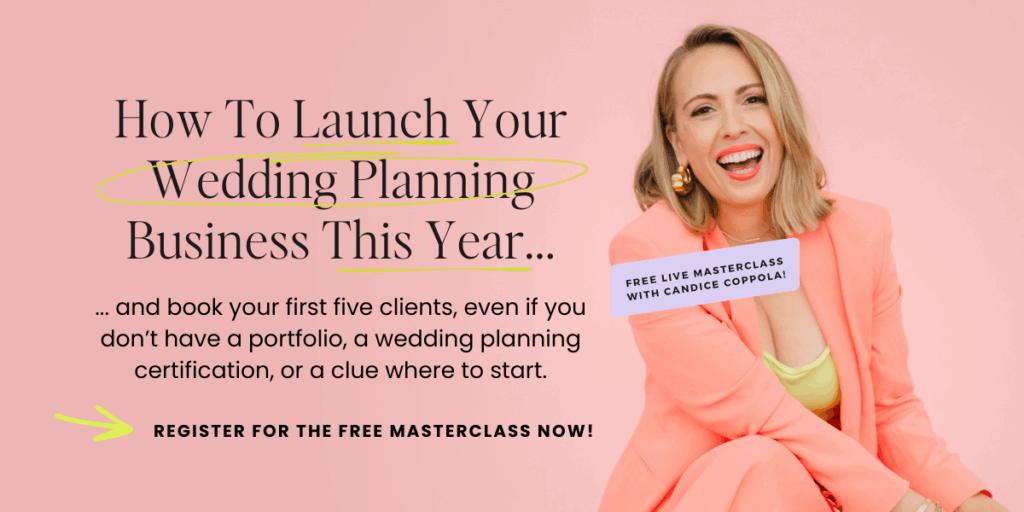
If your curiosity is turning into something more, I’ve created a free class designed to help you explore wedding planning as a business in 2026 (and book your first five clients).
Inside, I share how to:
- Think like a business owner, not a hobbyist
- Understand what the work actually requires
- Decide whether this path truly fits the life you want to build
And if it does, you’ll walk away with a clearer sense of how to approach it (aka with structure, boundaries, and confidence from the start), then Sign up now!
Frequently Asked Questions About Becoming a Wedding Planner
Do I need experience or certification to become a wedding planner?
No, but you do need a plan. Many successful wedding planners didn’t start with industry experience, but they did start by treating this like a business from day one. If you want to hear my hot take on certifications check out this post.
How much do wedding planners make in 2026?
Income varies widely and depends far more on business models than years of experience. Some planners struggle to break even, while others build six-figure businesses planning fewer weddings than you’d expect. Location plays a factor too. Having a strong pricing strategy as a wedding planner is key.
The average wedding planner makes $50-$100K a year while luxury wedding planners can make multiple six-figures!
Is the wedding industry oversaturated?
There are a lot of new planners entering the industry but there’s still strong demand for planners who are positioned clearly and operate professionally. The market isn’t saturated with experts; it’s crowded with generalists and hobbyists. Differentiation is what creates opportunity!
When I see a saturated market, I see a lot of opportunity because it means there is demand. So, don’t let the fact that there are multiple wedding planners in your city/state/country deter you from starting your career – see it as evidence of your eventual success.
Do wedding planners have to work every weekend?
Most wedding planners do work weekends during event season, especially early on. That said, how often, and for how long, depends on how you structure your services, pricing, and calendar. Flexibility is possible, but it comes from boundaries and systems (all things I teach you).
Is wedding planning a good career if I’m creative?
Creativity is a great asset, but it’s only one part of the job. Wedding planning also requires leadership, communication, and decision-making. The most successful planners understand that creativity needs structure in order to thrive.
What’s the difference between an event planner and a wedding planner?
Event planners and wedding planners share many core skills, but they typically work in different contexts.
An event planner usually plans and manages a wide variety of events, such as corporate meetings, conferences, nonprofit fundraisers, and private celebrations. The role often emphasizes logistics, timelines, budgets, and vendor coordination across shorter planning cycles.
A wedding planner focuses specifically on weddings, which tend to involve longer planning timelines, more personal decision-making, and a narrower type of event. Wedding planners work closely with couples over many months, helping coordinate logistics, manage vendors, and support the overall planning process from start to finish.
Both roles require organization, communication, and strong project management skills. The choice between the two often comes down to the type of events you enjoy, the clients you want to work with, and the kind of work rhythm you prefer. Many professionals choose to offer both!
Can wedding planning be a sustainable, long-term career?
Yes, when it’s approached intentionally. Planners who burn out often underprice, overextend, or avoid the business side. Those who build sustainable careers focus on profitability, boundaries, and alignment with the life they want to live.
What’s the biggest mistake new wedding planners make?
Trying to do everything for everyone. Underpricing, over-delivering, and waiting to “feel ready” before acting like a professional are common early mistakes. You can find a full list of the most common mistakes wedding planners make here.
How do I know if wedding planning is right for me?
If you enjoy leading, making decisions, and balancing creativity with responsibility, wedding planning may be a great fit. If you’re hoping for flexible income without boundaries or leadership, it’s worth reconsidering.
Explore More Wedding Industry Resources
- 4 Smart Ways to Scale Your Wedding Planning Business This Year
- How to Become a Certified Wedding Planner
- Should You Work For Free As A Newer Wedding Planner To Gain Experience? My Honest Opinion
- How to Start a Wedding Planning Business
- Should You Offer Wedding Weekend Planning Packages? Here’s The Truth.
- 10 Bold Shifts High-Achieving Wedding Pros Are Making Right Now (That Are Actually Working)
- Should You Increase Your Price? How to Know When It’s Time to Raise Your Rates
- A Complete List of Wedding Planner Expenses
- The Biggest Wedding Pricing Mistakes Keeping Wedding Planners Stuck Under $100K
- 6 Things You Need to Include In Your Wedding Planner Pricing Guide
- Pricing Mistakes You Can’t Afford To Make In Your Business As A Wedding Pro
- How to Get More Wedding Leads from Referrals as a Wedding Planner
- Wedding Planner Pricing: How Much Should You Charge As A Wedding Planner? Learn How To Figure Out Your Price
- Why Honeybook Is The Best CRM for Wedding Planners
- Stand Out in a Saturated Market: Performing a SWOT Analysis as a Wedding Planner
- Are You a Disorganized Wedding Planner? Let’s Fix That With These Organized Wedding Planner Tips!
- How To Build Your Portfolio As A Wedding Planner When You’re Just Starting Out
- Day of Coordination: The Pros and Cons as a Wedding Planner
- Wedding Planner Problems: The BIGGEST Problems Wedding Planners Deal With
- How To Get Wedding Clients When You’re Just Starting Out
- 5 Contracts Every Wedding Planner Must Have To Be Legally Set
- How To Become A Destination Wedding Planner
For More Wedding Planner Business Secrets Follow Me On Instagram
Buying stuff regulates my nervous system 🤷🏼♀️

The dates on these photos represent the year I first started coaching each of these women. Some of these relationships are newer, and others go back YEARS.
And I NEVER take for granted how lucky I am to do this work.
To be invited into someone’s business, help her accomplish new things, navigate new challenges, make hard decisions, and push herself in ways she might not have thought possible is a PRIVILEGE.
Because the work we do together is about so much more than growing a business.
I think there’s a big difference between learning from someone and having someone as a constant in your life. Someone who knows your business, history, understands what you’re working toward, and can be both a coach and a confidant through all the different seasons of entrepreneurship.
That’s what I get to be for these women. And what makes it even more special is that we’ve built a community of women who genuinely want to stick around. Not just for me, but for each other.
I feel so incredibly fortunate that these women continue to invite me into their businesses, year after year. It’s a privilege I don’t take lightly.
If you’ve been looking for a business coach who can be that person for you, I’d love to invite you to come hang out with us.
Applications for WeddingPro Insiders are open, and I have a handful of spots available.
Maybe next year, we’ll get to add your picture to this wall, too!!
Learn more and apply at weddingproinsiders.com
Photography @c10ike !!!
We don’t know where that energy has been, and frankly, I’m not taking any chances.
Before you move your wedding planning business to Cue, we’ll be conducting a brief spiritual background check on your laptop. The dogs are licensed. Please cooperate.
Comment CUEWAITLIST and I’ll send you the link to join the waitlist. Cleansing included.
filed under:












+ show Comments
- Hide Comments
add a comment